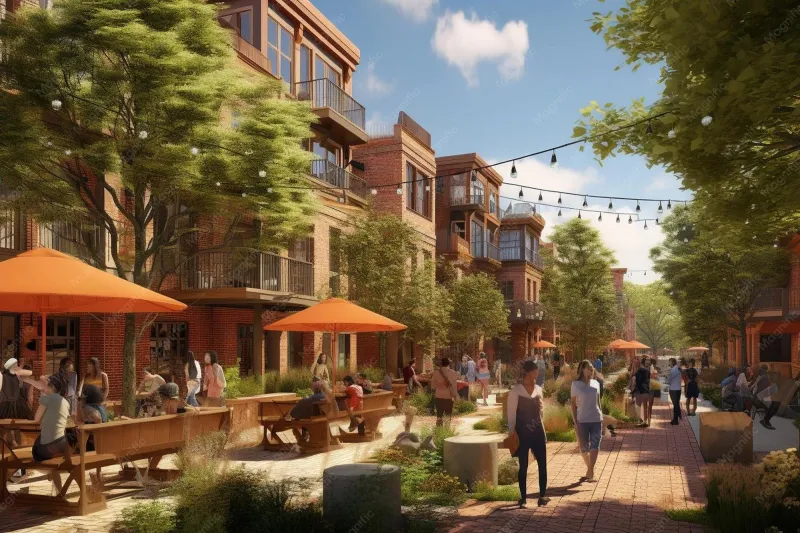
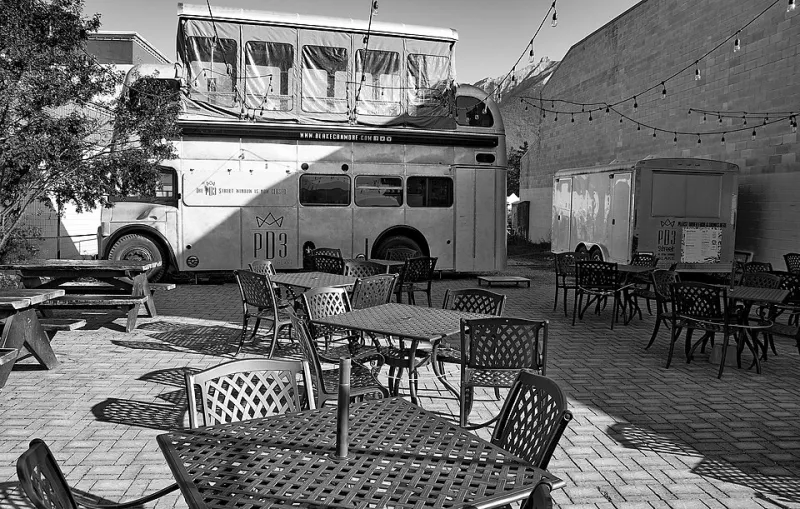
Brick Walls and Venture Capital: Why Founders Are Choosing Repurposed Industrial Addresses Over Gleaming Tech Campuses
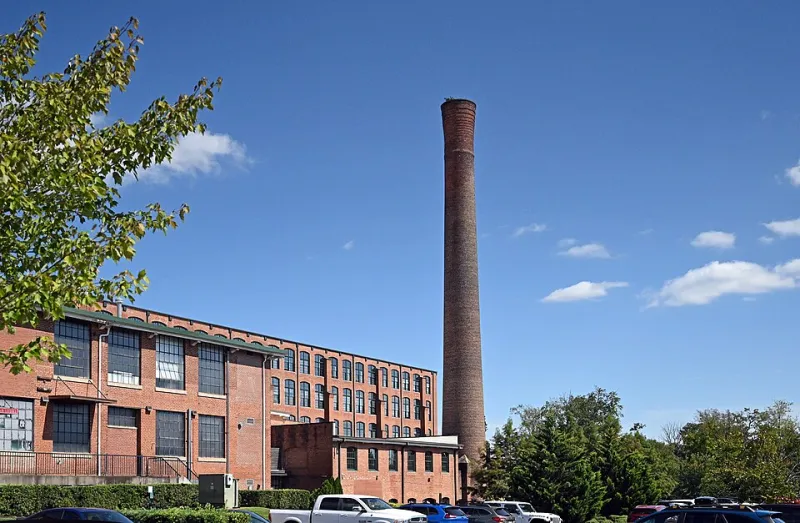
Photo: P. Hughes, CC BY 4.0, via Wikimedia Commons
There is a particular quality of light that enters through a twelve-foot factory window on a clear morning — diffuse, even, and generous in a way that no drop ceiling or fluorescent panel has ever replicated. Founders and creative directors who have worked in adaptively reused mill buildings describe this quality with a consistency that initially sounds sentimental but turns out to be economically significant. The built environment, it seems, is not a neutral backdrop to the work of innovation. It is a participant in it.
This insight — that the character of a workspace address influences the quality of the people it attracts, the culture it sustains, and ultimately the value it generates — is reshaping where venture capital flows and where the most ambitious enterprises choose to plant their flags.
The Economics of Authenticity
The adaptive reuse trend in commercial real estate is not new. Conversions of industrial buildings into loft apartments, galleries, and restaurants have been underway in American cities since at least the 1970s, when SoHo in New York became the canonical example of artists colonizing abandoned manufacturing space. What is new is the scale, the velocity, and the deliberateness with which venture-backed companies and the firms that fund them are now pursuing this category of address.
The economic logic begins with overhead. In markets like San Francisco, Austin, and New York, Class A office space commands lease rates that can represent a meaningful portion of an early-stage company's operating burn. Repurposed industrial space in secondary markets — cities like Providence, Pittsburgh, Lowell, Knoxville, and Richmond — frequently offers comparable square footage at 40 to 60 percent lower cost per square foot. For a company managing a Series A or Series B runway, that differential is not cosmetic. It is existential.
But cost alone does not explain the migration. If it did, the most financially rational founders would simply move to the least expensive office parks in the least expensive metros, and no such trend has materialized. The draw of adaptive reuse addresses is more layered.
What Founders and Creatives Actually Want From Their Address
Property owners and developers considering this market would benefit from understanding the specific attributes that drive leasing decisions among the companies most likely to anchor an adaptive reuse project.
First, physical authenticity. Exposed brick, original timber framing, cast-iron columns, and industrial glazing are not merely aesthetic preferences. They function as brand signals. A company whose workspace communicates craft, permanence, and a connection to the productive history of American industry is communicating something about its own values — and that communication reaches employees, clients, and prospective hires before a single word is spoken.
Second, spatial flexibility. The open floor plates characteristic of former manufacturing buildings accommodate the fluid, non-hierarchical arrangements that knowledge-economy companies favor. The same square footage that once housed looms or printing presses can be reconfigured as a collaboration space, a demonstration lab, or a hybrid work environment without the structural constraints that define conventional office construction.
Third, and perhaps most critically, neighborhood identity. Companies relocating to adaptive reuse addresses are not simply leasing square footage. They are affiliating with a place — a mill district, an industrial corridor, a riverfront precinct — that carries its own narrative. In a labor market where employers compete intensely for younger workers who prioritize meaning and environment over compensation alone, that narrative has measurable recruiting value.
The Multiplier Effect on Surrounding Addresses
When a single high-profile tenant — a venture-backed software firm, a design studio, a biotech startup — commits to an adaptive reuse address in a secondary market, the economic effects radiate outward in ways that property owners in adjacent blocks have every reason to monitor closely.
The pattern is well-documented. An anchor tenant generates foot traffic, attracts service businesses, elevates the perceived desirability of the district, and — critically — signals to subsequent tenants that the location has been validated by a credible early adopter. In cities like Pittsburgh's Strip District, Providence's Jewelry District, and Detroit's Corktown, the arrival of a single prominent employer in a repurposed industrial building has preceded measurable increases in surrounding property values and lease rates within 18 to 36 months.
For property owners who identify these dynamics early, the opportunity is significant. Buildings that appear to offer limited upside on conventional income metrics — older construction, deferred maintenance, unconventional floor plates — may carry substantial latent value if they are positioned correctly for the tenant category that is actively expanding its footprint in exactly these environments.
What Investors Should Be Evaluating
The adaptive reuse opportunity is not uniformly distributed. Not every former mill building in every secondary market is positioned to attract venture-backed tenants and creative industry anchors. Investors and property owners seeking to capitalize on this trend should evaluate several factors with particular care.
Proximity to university research infrastructure matters considerably. Cities with strong engineering, design, or life sciences programs generate a pipeline of talent that knowledge-economy tenants require. Addresses within a reasonable distance of these institutions — without being priced into the immediate campus market — occupy a productive middle ground.
Municipal incentive structures are equally important. Many secondary-market cities have enacted historic preservation tax credits, adaptive reuse ordinances, and enterprise zone designations that substantially improve the economics of conversion projects. Understanding the specific regulatory and financial environment of a target market is prerequisite to accurate underwriting.
Finally, the physical condition and structural integrity of the building itself must be evaluated honestly. Adaptive reuse projects that celebrate original materials and construction methods require those materials to be genuinely sound. A building whose historic character is performative rather than substantive will not sustain the tenant relationships that drive long-term value.
The Address as Competitive Advantage
At 118 Mill Street, the conviction that an address is more than a location — that it carries history, identity, and the capacity to shape what happens within its walls — is foundational. The adaptive reuse movement, in its current form, is a market-scale validation of that conviction.
Founders who choose a brick-and-timber industrial address over a glass-and-steel campus are making a statement about what kind of company they intend to build. Investors who recognize the financial logic embedded in that statement — and who identify the properties best positioned to serve it — are not simply following a trend. They are reading the built environment with the same rigor they apply to any other investment thesis.
The gold rush metaphor has its limitations. Unlike mineral extraction, the value embedded in a well-situated, authentically historic industrial address is not depleted by use. In the right hands, it compounds.